
Solar Power Plant for Artesian Boreholes with VodoZir Dispatch Control
Solar power plant for an artesian borehole with VodoZir dispatch control: water during blackouts, the sun powers the pump, the tower carries the load through the night. A complete package in a single cabinet
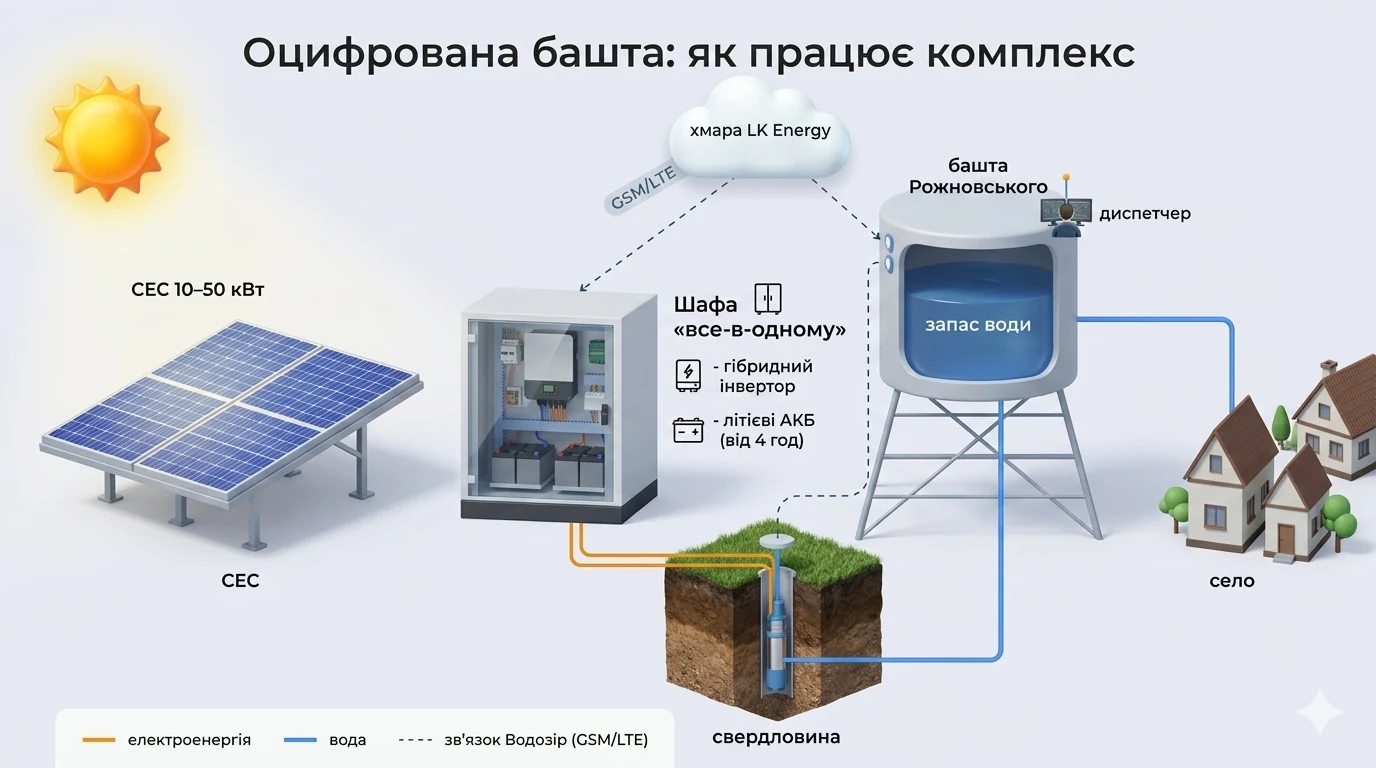
An energy-independent borehole: the village has water during a blackout — during the day from the sun, then from the batteries and the tower's reserve. A ready-made complex for a borehole with a Rozhnovsky-type water tower — a solar power plant, lithium batteries, a soft starter or a variable-frequency drive, and LK Energy's own VodoZir dispatch control device, all in a single insulated, vandal-resistant cabinet made by LK Energy. When the grid goes down, the pump automatically switches to solar and battery power, and the tower holds a reserve of water (essentially a free battery): within that reserve, the village doesn't notice the outage. And on ordinary days the complex simply earns its keep: the pump draws water during the day from the sun, electricity bills go down, and the dispatcher sees every site from a phone. For community water utilities and farmers with their own boreholes.
Sound familiar?
A blackout — and the village is without water until someone brings and starts a generator. Electricity bills are one of the largest cost items in water supply, and the tariff for legal entities keeps rising. Whether the pump is working or not — you find out when people call to say there's no water. Every month someone has to drive around all the towers to record the meter readings. And the borehole itself stands unattended in a field: an open cabinet or a cut cable — that too you "find out about later."
If at least three of these points describe your operation, read on.
Insight: the Rozhnovsky tower is a free battery
A tower is a tank of 15/25/50 m³ on a support 10–18 m high. That height is enough to distribute water by gravity at a pressure of ~1.0–1.8 bar — no pump is needed for distribution. This is exactly what decouples the pump's operating schedule from the consumption schedule: the pump can run when it's advantageous (during the day, from the sun), while the village draws water when it needs to (morning and evening).
For boreholes with a typical total head of 80–100 m, each cubic meter in the tank is ≈0.4–0.5 kWh of electricity already "stored" in the form of lifted water (at a lower head the figure is proportionally smaller — we account for this in the calculation). A 25 m³ tank is 10–12 kWh, a 50 m³ tank is 20–23 kWh of "virtual battery." A lithium battery of that capacity costs real money, while the tower is already standing there and has long been paid for. We simply add a "brain" (dispatch control) and a "source" (a solar power plant) to it — this is what we call "digitizing the tower."
Nighttime water draw in a village is typically 10–20% of the daily total (based on statistics from our sites), so a tank filled in the evening carries the village through the night without a single kilowatt from the grid: the sun pumps by day — the tower holds through the night. For larger villages we verify the sufficiency of the tank volume by calculation.
An important point of honesty: the tower stores water (and unpurchased nighttime kilowatt-hours for the pump), not electricity. It won't light the houses — only continuity of water supply.
Blackout protection: there is water even when there's no grid
Water is critical infrastructure. When the grid goes down after shelling or an accident, a village without water is not an "inconvenience" — it's an emergency. That's why the complex's main task is to keep a blackout from reaching the tap. The layers of protection switch on automatically, without human involvement:
- Sun
- During the day the pump is powered by the solar power plant — it doesn't need the grid.
- Batteries
- Without sun, the pump switches to lithium batteries — capacity sized for at least 4 hours of its operation.
- Tower
- Even when the pump is stopped, the village draws water by gravity until the tank empties — that's still hours of reserve.
- Diesel generator
- (if there is one at the tower) starts last — only when the sun, the batteries, and the tank reserve are exhausted.
When the connection is lost, VodoZir keeps controlling the pump autonomously, while the dispatcher sees on the panel that the site has switched to reserve power — and learns about the blackout at the borehole before the first resident calls.
Why diesel comes last: at June 2026 prices (diesel fuel ≈84–87 UAH/liter), just the fuel component of a kilowatt-hour from a diesel generator set is around 25–26 UAH at a consumption of 0.3 l/kWh for a well-loaded generator. A small pump on a typical 10–16 kVA diesel generator set runs under partial load and burns 0.4–0.6 l/kWh — in which case the kilowatt-hour becomes another one-and-a-half to two times more expensive. With maintenance and depreciation — from ~30 UAH and up. Every hour on solar, batteries, and the tower's reserve is unburned fuel, preserved engine life, and zero manual startups.
An honest limit: the autonomy of the water supply equals a sunny day plus the batteries plus the tank reserve, after which it's the diesel generator set. The complex will not indefinitely cover a multi-day winter overcast without a generator, and we don't promise that.
A ready-made product: the borehole's entire power system in one box
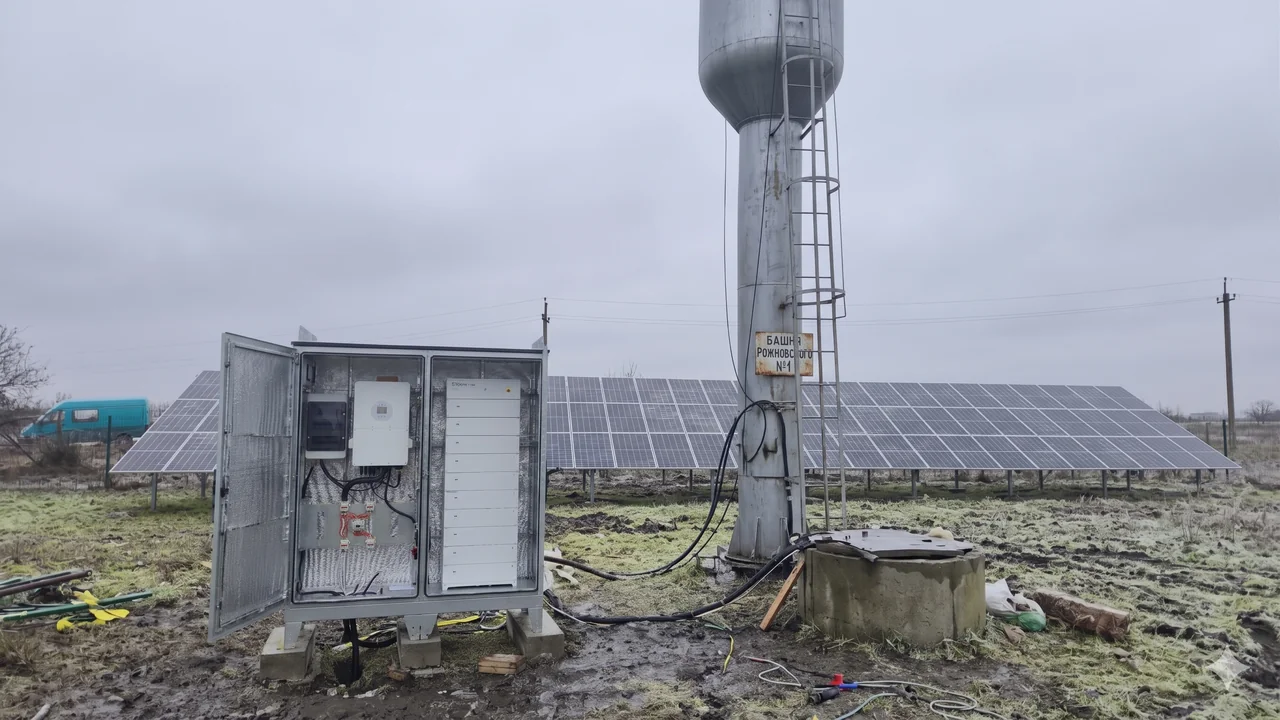
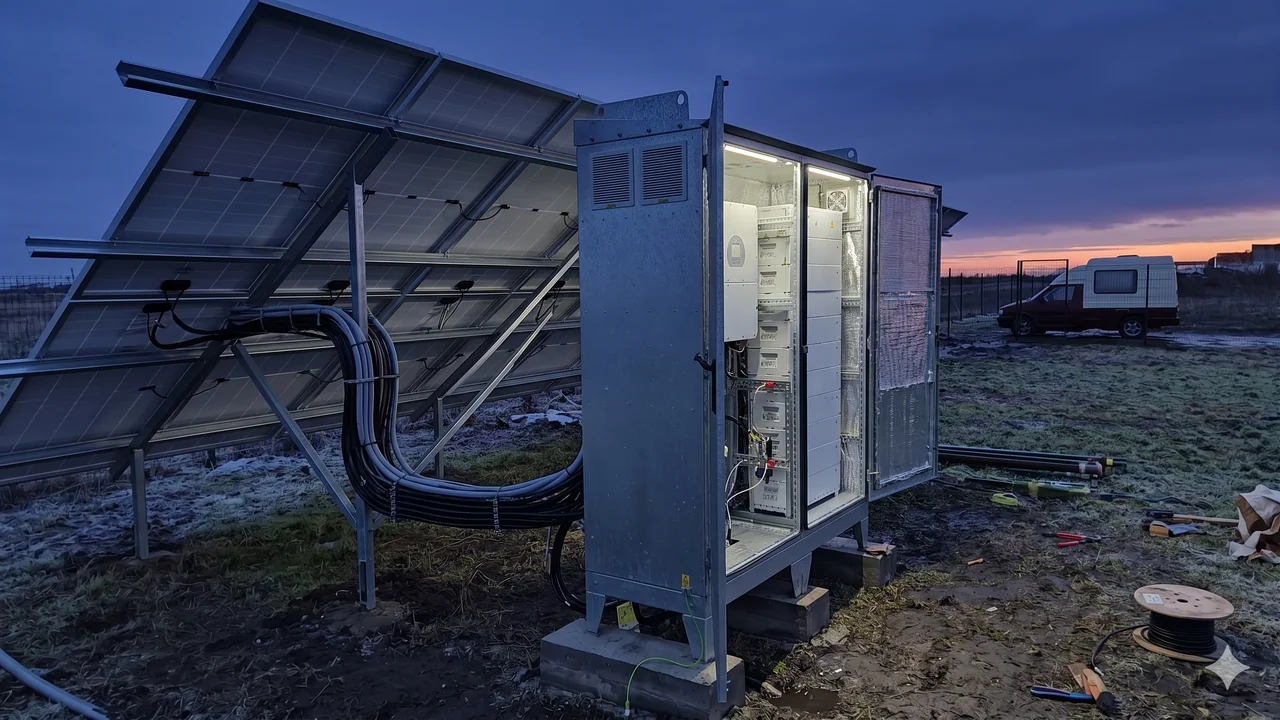
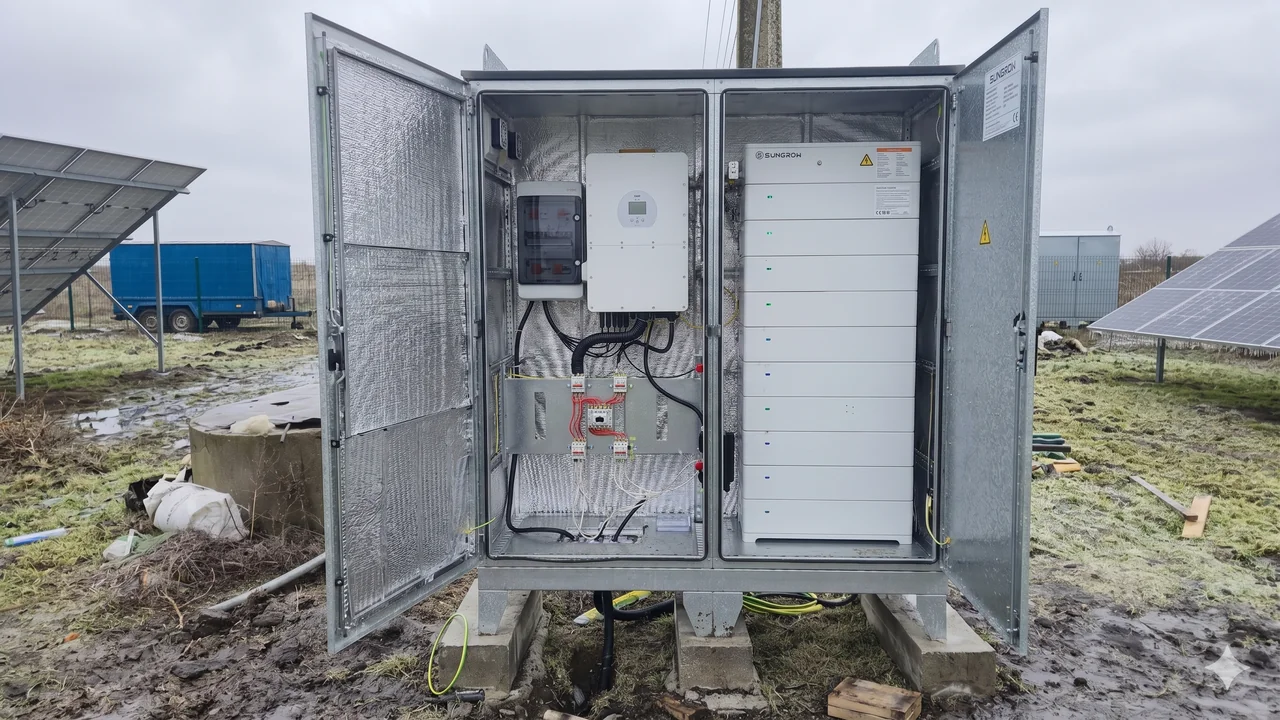
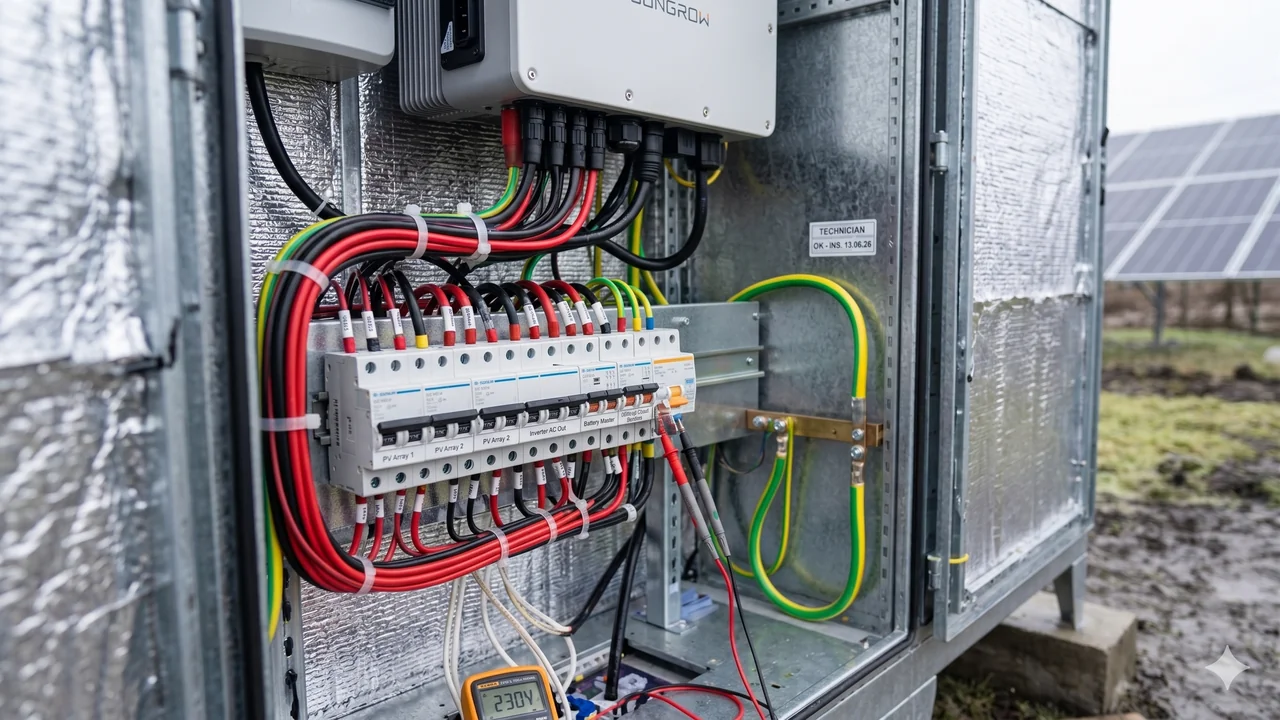
We install a finished product on the borehole, not a "list of equipment." In a single insulated, vandal-resistant cabinet made in-house by LK Energy:
- a hybrid inverter — runs on solar, grid, and battery power;
- lithium batteries (LiFePO4) — capacity sized for at least 4 hours of autonomous pump operation;
- a soft starter device (for pumps up to 11 kW inclusive) or a variable-frequency drive (over 11 kW, or wherever pressure needs to be regulated);
- LK Energy's own VodoZir dispatch control device;
- a 50 mm sandwich panel, thermostat-controlled heating, ventilation, sensors, and a tamper alarm.
The heating isn't a comfort feature — it's a functional requirement: lithium batteries must not be charged below 0 °C, and the BMS blocks charging in frost. An uninsulated box in winter — exactly when blackouts are most likely — means a battery with no charge and zero reserve. The cabinet keeps the batteries within their operating temperature window: in deep frost the heating draws roughly 1–2 kWh per day, against 16–44 kWh of battery capacity; this is accounted for when sizing the capacity. In summer, ventilation keeps the lithium from overheating.
We make the cabinets ourselves: electrical installation experience of over 20 years (since 2005), our own production of switchgear equipment for 11 years, more than 3,000 units produced since 2015. More detail — equipment manufacturing.
Why a soft starter is not optional
The numbers are these: a direct start of a submersible pump produces a current surge 5–7 times the rated value. A soft starter device limits it to roughly 2.5–3 times the rated value — it can't go lower, because the pump won't move against the head. A hybrid inverter can briefly withstand 2–3 times the rated current — meaning a softened start fits within its capability only when the inverter is selected with a margin for the specific pump's starting current. That sizing is part of the package calculation. During a blackout the inverter has to start the pump entirely on its own, without the grid, so the pairing of "soft starter + a correctly sized inverter" (and, from 11 kW, a variable-frequency drive) is not an option but a condition for the entire backup chain to work (sun → batteries → tower → generator). A bonus: a smooth ramp-up and stop eliminate water hammer in old rural networks and protect the most expensive component — the submersible pump, whose replacement means pulling up the pipe string, a mobile crane, and days of downtime.
When we install a variable-frequency drive
From 11 kW, even a softened starting surge is too large — a variable-frequency drive ramps the pump up from a low frequency within the rated current, and there is almost no start-up event at all. The second reason is stable pressure where the pump feeds not only the tower but also directly into the network. The third is dry-run protection: the pump can be "throttled back" to match the borehole's yield. What a variable-frequency drive does not do is "save 30–50% of electricity": in a borehole, static head dominates, so the classic savings from reducing rotation speed don't apply here. The savings come from the sun and from aligning the schedules.
How VodoZir dispatch control works
The VodoZir device collects, from the site, electricity meter and water flow meter readings, the tank level and/or engine hours, and the pump's status and faults. What this provides:
- Readings — remotely
- Routine trips around the towers just to record figures are no longer needed (scheduled equipment inspections are, of course, not cancelled).
- Faults — by notification, not by a phone call from residents
- The pump is on but there's no flow — a supply failure or a break. The level drops while the pump is running — a major leak. Dry running. The cabinet has been opened. The dispatcher finds out first. If the connection is lost, the device keeps controlling the pump autonomously according to the last schedule.
- Schedule-based pump control
- Draw-off statistics build a typical daily consumption profile for the village. The controller plans how much water needs to be lifted per day and schedules the pump's operation within the window of solar generation, topping off the tank before the evening peak. If the level drops to the emergency threshold, the pump switches on regardless of sunlight.
Aligning the generation schedule with the draw-off schedule provides additional savings — if the operating mode allows it: a site without storage and control self-consumes ~50–60% of the solar generation, while the combination of "batteries + dispatch schedule" raises the share to a calculated 75–85%. The difference between these figures is the money that the complex's "brain" gives back.
A related area for water utilities is dispatch control for sewage pumping stations.
Scale of savings: calculation for five size classes
Below are examples with stated assumptions, not a guarantee. Every figure is derived from formulas and is recalculated for the specific site.
Assumptions: generation — PVGIS (the European Commission's official European solar generation database, JRC) for Odesa, fixed mounting at 35°, losses of 14%: 1,278 kWh/kWp per year (matching the actual performance of real Odesa-region plants — 1,260–1,310); consumption — actual annual data from community boreholes; tariff — month-by-month based on actual bills for legal entities at voltage class 2 (2026): from ~11 UAH/kWh incl. VAT in summer to ~14 UAH in winter; for VAT payers, savings are calculated at the tariff excluding VAT (÷1.2); usable energy — a month-by-month balance of generation and consumption accounting for the batteries and the dispatch schedule; surplus generation is not sold.
| Parameter | Solar plant 10 kW | Solar plant 15 kW | Solar plant 20 kW | Solar plant 30 kW | Solar plant 50 kW |
|---|---|---|---|---|---|
| Borehole consumption, kWh/year (actual) | 10,066 | 16,317 | 25,958 | 32,847 | 56,805 |
| Solar plant generation, kWh/year (PVGIS) | 12,784 | 19,175 | 25,567 | 38,350 | 63,918 |
| Covered by solar, kWh/year | 9,310 | 14,855 | 22,595 | 29,864 | 51,251 |
| Consumption coverage | ≈92% | ≈91% | ≈87% | ≈91% | ≈90% |
| Savings, UAH/year | ≈93,000 | ≈148,000 | ≈223,000 | ≈297,000 | ≈509,000 |
* Indicative values based on actual borehole data; exact savings are calculated for your specific site. Less than 10 kW? We'll calculate it individually.
The batteries in each package are sized for at least 4 hours of operation of the specific borehole's pump. From March to October, consumption is fully covered by solar; from November to February, the grid buys in the difference. The cabinet's own consumption (controller, winter heating) of ~300–500 kWh/year is not deducted in the table — it is accounted for in the precise feasibility study.
Month-by-month breakdown: a 30 kW plant at a large water intake
For a water intake with consumption of ~32,800 kWh per year (a pump in the 11–15 kW class), we install a 30 kW solar plant. The month-by-month generation profile — PVGIS for Odesa, fixed mounting at 35°, losses of 14%, 1,278 kWh/kWp per year:
| Month | 30 kW plant generation, kWh | Consumption, kWh | Covered by solar, kWh |
|---|---|---|---|
| January | 1,547 | 1,941 | 1,547 |
| February | 1,908 | 2,042 | 1,908 |
| March | 3,241 | 2,599 | 2,599 |
| April | 4,044 | 2,484 | 2,484 |
| May | 4,411 | 2,380 | 2,380 |
| June | 4,445 | 2,952 | 2,952 |
| July | 4,682 | 4,001 | 4,001 |
| August | 4,649 | 3,699 | 3,699 |
| September | 3,820 | 2,886 | 2,886 |
| October | 2,792 | 2,597 | 2,597 |
| November | 1,521 | 2,455 | 1,521 |
| December | 1,290 | 2,811 | 1,290 |
| Total for the year | 38,350 | 32,847 | 29,864 |
The sun covers ≈91% of the annual consumption of this water intake. The solar plant is sized with a margin — part of the spring-summer surplus goes unused; from November to February generation is lower than consumption, and the grid makes up the difference.
Savings: ≈297,000 UAH per year (calculated month by month — every kWh covered by solar × that month's tariff; for a VAT payer).
Estimated payback period for such a complex is 5–6 years: about 5 years accounting for rising electricity tariffs, up to 6 years at an unchanged tariff. After that — 20+ years of service with minimal consumption from the grid.
The cost of the package depends on the pump's power, the battery capacity, and the starter configuration, so we don't publish "prices from…": we calculate the estimate and the exact payback period for free based on your tower's data.
Tariffs and prices — as of June 2026: Market Operator day-ahead market indices, NKREKP (National Energy and Utilities Regulatory Commission) transmission and distribution tariffs, actual regional power company bills, retail diesel fuel price monitoring. We update these when the market changes materially.
Financing for communities
A solar plant at a water intake fits the criteria of current programs (list as of June 2026; compliance is verified at the application-preparation stage):
- DFRR (State Fund for Regional Development)
- state support for community regional development projects, submitted via the DREAM platform, with local budget co-financing of at least 10%.
- NEFCO
- municipal energy efficiency and water supply modernization programs; there are precedents of water utilities modernizing with solar plants for their own needs.
- EIB (Ukraine Water Recovery)
- long-term concessional loans for large water supply projects: a package of dozens of community or district boreholes.
- Grant programs
- donor projects such as "Solar Aid" install solar plants on critical infrastructure, including water utilities.
A separate mechanism on the market is an ESCO (energy service contract): an investor finances the complex, and the customer pays from the achieved savings. We do not provide such contracts ourselves — we work as the contractor and manufacturer of the package. But we prepare the technical part (calculations, specifications, month-by-month balances) for whichever financing model the community chooses.
Frequently asked questions
Will there be water during a blackout?
Yes, within the cascade: during the day the pump is powered by the sun, then by the batteries (sized for 4 hours of pump operation), and the diesel generator starts last, if there is one at the tower. Plus the water reserve in the tower itself: the village has water even when the pump is stopped. The complex will not cover a multi-day winter overcast without a diesel generator — that is an honest limit.
How much does a solar plant for a borehole with dispatch control cost?
It depends on the pump's power (which determines the inverter, the size of the solar plant, and the battery capacity) and the configuration — soft starter or variable-frequency drive. So instead of "prices from…" we do a free calculation based on the data of your specific tower.
Can the complex be installed on an operating borehole without replacing the pump?
Yes. The complex connects to the existing submersible pump: for up to 11 kW inclusive we install a soft starter, above 11 kW or where pressure regulation is needed — a variable-frequency drive. There's no need to replace the working pump.
What about winter, when there's little sun?
In winter, generation is only a few percent of the annual total, and the pump is powered mainly from the grid. That's exactly why we present the annual calculation with stated assumptions. The cabinet's heating keeps the batteries within their operating charge window — reserve capacity for a winter blackout is preserved.
We already have level-based automation. Why do we need dispatch control?
A float switch turns the pump on, but it won't report a supply failure, a major leak, or an opened cabinet, and it won't take meter readings. And most importantly — it won't schedule the pump's operation within the solar generation window. The additional savings from aligning the schedules is specifically a function of VodoZir.
Are there financing programs for communities?
Yes: DFRR (via DREAM), NEFCO programs for municipal water supply, concessional EIB loans for large package projects, and grant programs for critical infrastructure.
Where to start
We offer a demonstration or pilot implementation at a single site: you choose one tower — we run the same formulas on its data, install the complex, and you show the community council the results with real figures. Fill in the form below or call +38 067 104-94-91 — we will get back to you within 24 business hours with a calculation based on your tower's data. LK Energy, Odesa.
A calculation based on your tower's data
Send us the data: pump power, annual consumption, tariff. We will calculate the savings and payback period for free — a reply within 24 business hours.
+380 67 104 94 91