
Backup Power for Industrial Facilities — Diesel Gensets, UPS, Hybrid
Backup power for business — BESS, diesel generators, hybrid systems, ATS. Full-cycle EPC from a 5 kW office to a 1+ MW facility. Sizing calculated for your load.
Backup power for business — BESS, diesel, hybrid systems
Blackouts, grid instability and the risk of outages have made backup power a basic business necessity. An ATM stops working — customers leave. A server goes down — data is lost. Refrigeration cuts out — a ton of product spoils. LK Energy (Odesa, since 2005) designs and installs hybrid systems based on BESS, diesel generators and automatic transfer switches (ATS) — from a 5 kW office to a 1+ MW industrial facility. Sizing for your load is typically ready within 24 business hours.
Quick guide — which is your case:
- Office, shop, restaurant
- a scheme with a UPS or battery is enough — see Scheme 2 or Scheme 3 below.
- Warehouse, production with an acceptable pause
- a classic diesel genset with ATS — Scheme 1.
- Bank, hospital, data center, critical facility
- a "battery + diesel" hybrid — Scheme 4.
Why backup power has become mandatory for business
Amid unstable power supply and the risk of both scheduled and emergency outages, uninterruptible power has become critical for any business where downtime means direct losses.
Important: The risks of outages and their impact on a specific facility are individual. LK Energy does not guarantee a specific percentage of uninterrupted operation — actual autonomy depends on the chosen configuration, maintenance procedures and fuel quality for the diesel part of the system.
Business consequences of outages:
- Direct losses
- spoiled product (food, pharmaceuticals), lost transactions (banks, e-commerce), halted production processes
- Indirect losses
- customer attrition due to service downtime, reputational risk, lost contracts due to SLA breaches
- Digital disaster
- a server room without a UPS means damaged databases, lost sessions, corrupted file systems
Who needs backup power (typical clients)
| Segment | Why it's critical | Approximate budget* |
|---|---|---|
| Corporate offices / business centers | Workflow continuity, IP telephony, server room | $5K — $50K |
| Banks + ATMs | NBU (National Bank of Ukraine) requirements for operational continuity, movement of funds | $15K — $200K |
| Data centers (Tier III/IV) | Uptime SLA 99.9%+, N+1 / 2N redundancy | $100K — $1M+ |
| Hospitals and medical centers | DBN (State Building Codes) B.2.2-10:2022, Reliability Category I under the PUE (Electrical Installation Rules) for critical consumers | $50K — $500K |
| Food industry enterprises | Cold storage chambers, production cycle | $30K — $300K |
| Gas/CNG filling stations | Refueling transactions, safety, business continuity | $10K — $80K |
| Retail / shopping malls | POS systems, lighting, refrigeration equipment, pumping stations | $15K — $150K |
| Restaurant businesses | Kitchen (stoves and ovens), refrigerators, POS | $5K — $30K |
| Server rooms / telecom hubs | Critical infrastructure, UPS + generator mandatory | $20K — $200K |
| Security systems (cameras / access control) | Monitoring continuity, security | $3K — $20K |
*Budgets are approximate, excluding VAT, and are calculated individually based on a load audit.
Found your segment? The first step is a load audit (see the "How to choose a scheme" section), then we select the scheme and calculate the estimate.
Solution architecture — 4 typical schemes
Scheme 1: Diesel + ATS (classic, cheapest)
Configuration:
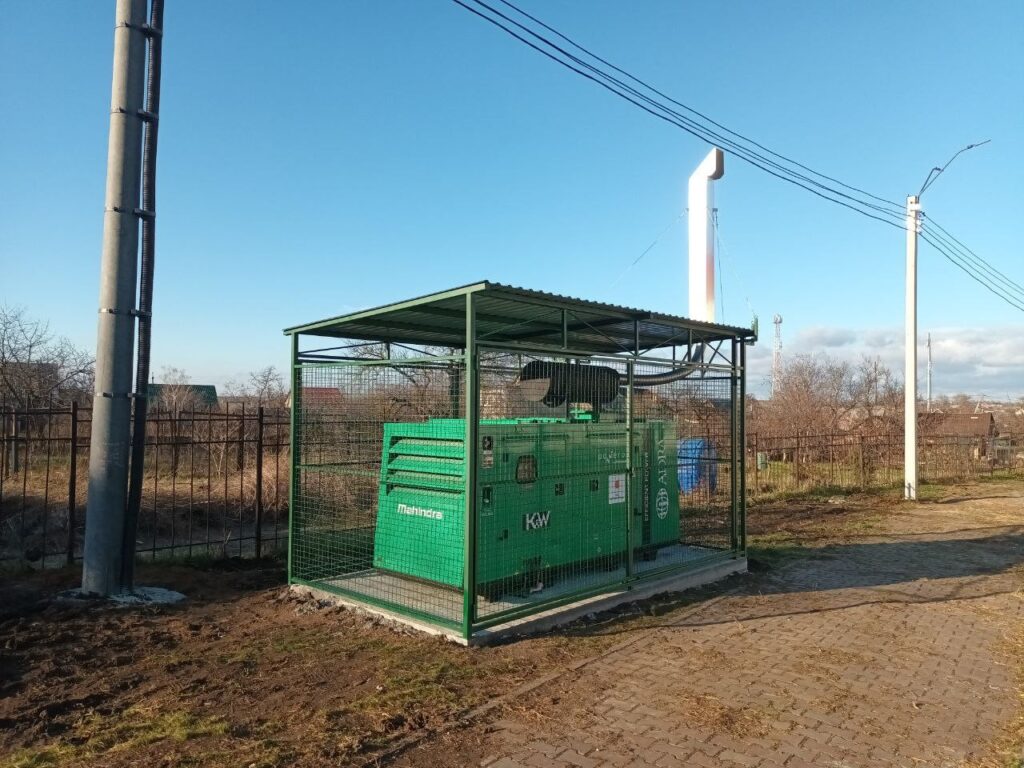
- Diesel generator (10-1000 kW)
- Automatic transfer switch (ATS)
- Fuel system (tank, fuel filling and distribution unit)
- Switching time: 5-15 seconds
- Suitable for: non-critical loads where a break of a few seconds is acceptable (warehouse, production with restart-friendly processes)
- Budget: cheapest (from $5K for a small installation)
- Drawbacks:
- A short power interruption causes PCs, servers and server equipment to reboot
- Noise, vibration, exhaust fumes — requires separate placement or a soundproof enclosure
- Requires scheduled maintenance and regular refueling
Scheme 2: UPS + Diesel + ATS (standard for a bank, office)
Configuration:
- Online double-conversion UPS — powers critical loads without a break of even a millisecond
- Full-power diesel generator
- ATS switching between generator and grid
- Switching time: ≈0 seconds (the online UPS bridges the interval without a break)
- Suitable for: offices, banks, pharmacies, server rooms up to Tier II
- Budget: $15K — $80K (depending on UPS power)
- Drawbacks:
- UPS batteries are a service item every 3-5 years (replacement $1-3K)
- Two systems mean two maintenance contracts
Scheme 3: BESS + ATS (quiet, fuel-free)
Configuration:
- BESS (Battery Energy Storage System) — Li-ion / LiFePO4
- Hybrid inverter-charger
- ATS switching
- Switching time: ≈0 seconds (the BESS operates online like a UPS)
- Autonomy: 2-12 hours (depending on BESS capacity and load)
- Suitable for: offices, retail, telecom hubs, non-bank critical facilities
- Budget: $20K — $200K
- Drawbacks:
- Limited autonomy compared to diesel (fuel can be added, batteries cannot)
- Higher capital costs than a classic diesel setup
- LiFePO4 battery degradation of ~1-3% per year depending on operating mode
Scheme 4: BESS + Diesel + ATS (Tier III hybrid, most reliable)
Configuration:
- BESS for 1-4 hours of autonomy
- Full-power diesel for extended outages
- Smart controller: the BESS covers short outages, the diesel starts only for extended ones
- Multi-stage ATS (mains → BESS → diesel genset)
- Switching time
- ≈0 seconds
- Autonomy
- theoretically unlimited (as long as fuel lasts)
- Suitable for
- data centers (Tier III/IV reliability classes), banks, hospitals, large retail, critical telecom hubs
- Budget
- $100K — $1M+
- Advantages
- lowest total cost in the long run — less diesel engine runtime, less wear, less fuel
- Drawbacks
- highest CAPEX
*Prices are approximate, excluding VAT; the exact cost is calculated individually based on the technical specification, load type and chosen equipment brand.
How to choose a scheme — a practical guide
Step 1: Load audit
- Measure actual consumption (wattmeter, power quality analyzer)
- Separate critical vs. non-critical loads (for example: server room — critical; office air conditioners — non-critical)
- Calculate the peak start (motors under direct starting have an inrush current of 5-8× the rated value)
Step 2: Determine the required autonomy time
- What is the acceptable duration of a complete power outage?
- Office hours: typically 8-12 hours
- 24/7 services (banks, hospitals): 24+ hours of autonomy
Step 3: Budget vs. OPEX
- Diesel: cheaper CAPEX, more expensive OPEX (fuel, maintenance)
- BESS: more expensive CAPEX, cheaper OPEX (only the electricity used for charging)
- Hybrid: optimal TCO over 5-10 years
Step 4: Space and noise
- Diesel requires a separate ventilated room or an outdoor enclosure
- BESS is compact and can be placed in a technical room (LiFePO4 is more thermally stable than Li-NMC)
BESS — what to pay attention to
Battery chemistry:
- LiFePO4
- (Lithium Iron Phosphate) — recommended for buildings: thermally stable, resistant to thermal runaway, 6000+ cycles
- Li-NMC
- (Nickel Manganese Cobalt) — more compact, but requires thermal management
- Pb-acid
- (lead-acid) — recommended only for the UPS segment, not for BESS resilience applications
Key selection parameters:
- Depth of discharge (DoD) — should be ≥80% (LiFePO4 working DoD up to 90%)
- C-rate — the ability to deliver/accept power (1C = a full cycle in 1 hour)
- Manufacturer's warranty — typically up to 10 years or 6000 cycles
- BMS (Battery Management System) — mandatory, with protection against overheating / overcharge / undercharge
- Certification — UL 9540 / UL 9540A, IEC 62619, VDE 2510-50
Diesel generators — selection
Generator classes (per ISO 8528-1):
- Standby
- for blackouts, a limited number of hours per year, no overload
- Prime
- for regular use, with permissible overload
- Continuous
- 24/7 with no limits, rarely used in business
Manufacturers available in Ukraine: Cummins, Caterpillar, Perkins, FG Wilson, Volvo Penta and other leading brands, as well as Ukrainian manufacturers. The specific model is selected based on the facility's power and operating mode.
Key parameters:
- Active power (kW) = apparent power (kVA) × cos φ
- Starting type — electric starter from a battery (mostly 24V)
- Cooling type — air-cooled (up to 30 kW), liquid-cooled (above that)
- Emission standards — Stage IIIA / Stage V (European standards)
- Noise — ≤75 dB at 1 m for a sound-attenuating enclosure
ATS — automatic transfer switches
ATS (Automatic Transfer Switch) is the heart of a backup power system. Selection depends on:
- Power rating
- (A, kVA)
- Switching time
- (ms for UPS-grade, 5-15 s for classic units)
- Type
- open transition (brief interruption) vs. closed transition (synchronized, no break — for critical facilities)
We use ATS equipment from leading manufacturers (ABB, Schneider Electric, Eaton, Socomec, Siemens, etc.) — the model is selected based on the facility's power and class.
Special considerations for medical facilities
Medical facilities have Reliability Category I under the PUE (Electrical Installation Rules) for critical consumers — operating rooms, intensive care, maternity wards. This requires a backup source with automatic transfer switching in accordance with DBN (State Building Codes) B.2.2-10:2022 and the PUE; for the special group within Category I, an independent third source with a minimal power interruption is required.
Critical loads (100% backed up):
- Operating rooms
- Intensive care
- Laboratories with continuously operating equipment
- Server room, medical databases
- Gas supply systems (oxygen, medical gases)
- Evacuation route lighting systems
Recommended scheme: Scheme 4 (BESS + Diesel + ATS), with the BESS portion covering the critical load plus a full-power diesel genset.
Warranty, insurance, maintenance
Warranties from LK Energy:
- Installation: per the terms of the contract
- BESS: typically up to 10 years / 6000 cycles (passed through from the manufacturer)
- Diesel genset: 24-60 months (depending on the brand)
Construction and installation works (CIW) insurance — at the customer's request, we arrange insurance for construction and installation risks in accordance with the contract terms (in particular for critical facilities — banks, hospitals).
Recommended scheduled maintenance:
- Diesel generator: quarterly inspection, annual full diagnostics, oil change every 250 engine hours
- BESS: semi-annual BMS inspection, annual capacity test
- ATS: annual switching test
*Exact warranties and maintenance terms are fixed in a separate service agreement.
Questions and answers
1. How much does backup power for an office cost? Depending on the power and type — approximately from $5K (a small office on diesel) to $80K (BESS+diesel genset for a bank).* Sizing for your facility within 24 business hours.
*Approximate values, excluding VAT, calculated individually.
2. Do I need a permit to install a diesel generator? Yes, a permit from the local authority is required — especially if the installation will create noise affecting neighbors. LK Energy handles the permitting process.
3. How long does a BESS run on a single charge? Depends on the BESS capacity and the load. Typically 2-12 hours for an office configuration.
4. Can a BESS fully replace a diesel generator? For short blackouts (≤4 hours) — yes. For extended ones (10+ hours) — a BESS+diesel hybrid is more optimal.
5. What is the service life of LiFePO4 batteries? 6000+ cycles (approximately 15-20 years at one cycle per day), with a manufacturer's warranty typically up to 10 years.
6. Can a solar power plant be connected to the backup system? Yes, this is an Off-Grid / On-Grid hybrid. A hybrid inverter + BESS + diesel genset = full energy independence.
7. How quickly can you install it? Depending on the equipment: small systems 3-5 days, large ones (>200 kW) — 4-8 weeks from order (including supply).
8. Are BESS units safe in case of fire? LiFePO4 is significantly more resistant to thermal runaway than Li-NMC, thanks to its chemistry and higher temperature threshold. In addition, BMS control and an IP65 enclosure are used for outdoor installations.
9. Is a separate cable input required? Usually yes — a separate input for the diesel genset after the ATS. LK Energy includes this in the project.
10. Can an existing UPS system be upgraded by adding a BESS? Yes, typically the old UPS remains for critical loads, and the BESS is added in parallel for extended runtime.
Why LK Energy
- Over 20 years
- (since 2005) of EPC experience in the power industry
- Own installation crew
- plus service maintenance
- Derzhpratsi (State Labor Service) permits
- , working range 0.4–35 kV
- Service maintenance
- under contract (an SLA with a fixed response time is possible)
- Work with ProZorro tenders
- for government customers
- Documentation support
- from the technical specification to the acceptance certificate
Backup power sizing
Fill out the form — within 24 business hours we will send you a backup power calculation and a preliminary estimate for your facility. Please specify:
- Facility type (office / bank / hospital / production)
- Approximate load power (kW)
- Desired autonomy time (hours)
- Budget range (optional)
Or contact us directly — contact details are in the "Contacts" section.
See also: BESS Wenergy service · solar power plants for enterprises · project financing.
Backup power sizing for your facility
Describe your facility and the desired autonomy time — within 24 business hours we will send you a backup power calculation and a preliminary estimate.
+380 67 104 94 91